The 8 Algebra Mistakes That Cost the Most Marks
The eight structural algebra errors behind most lost marks — distributing a minus, cancelling terms, losing a root — each with the check that catches it in seconds.
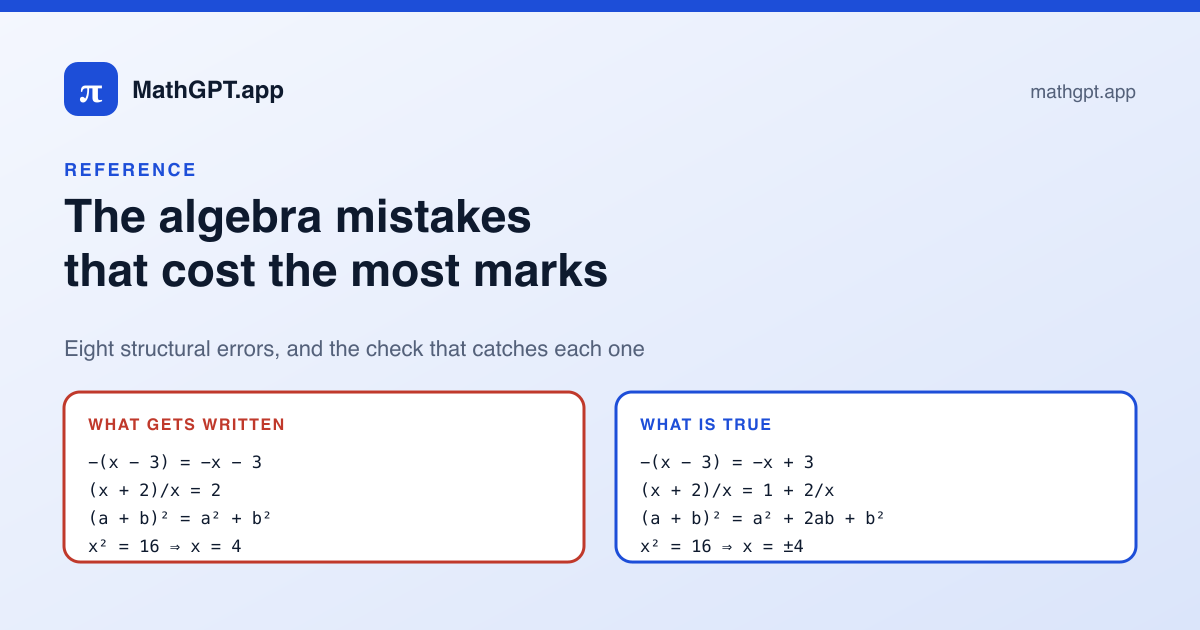
Lost marks in algebra are not randomly distributed. The same eight or nine errors account for most of them, they are all structural rather than careless, and every one of them has a check that takes seconds.
Here they are, in rough order of how much they cost.
1. Distributing a minus over only the first term
Wrong
-(x - 3) = -x - 3The minus reached the x and stopped.
Right
-(x - 3) = -x + 3Every term inside the bracket changes sign.
Check: substitute x = 0. The original gives 3, so the expanded form must also give 3.
The same error wearing a different hat: becoming rather than . Any time a minus sits in front of a bracket, expand it deliberately.
2. Cancelling a term instead of a factor
Wrong
(x + 2) / x = 2The x values are not factors of the numerator.
Right
(x + 2) / x = 1 + 2/xOnly a common factor of the WHOLE numerator cancels.
Check: x = 1 gives 3 in the original. The wrong version gives 2, and you know immediately.
Cancelling is division applied to the entire numerator and the entire denominator. If the numerator is a sum, nothing cancels until it is factored into a product.
3. Squaring a sum term by term
The middle term is the one that goes missing. The same applies to and . All three are the same underlying mistake: distributing an operation that does not distribute.
Test it with numbers once and you will not do it again: , not .
4. Losing a solution to an even power
Squaring destroys sign information, so taking a square root has to put both possibilities back. Writing alone is half an answer, and in a word problem it is often the wrong half.
The same applies to , which is two equations, and to any even power at all.
5. Keeping an extraneous root
Squaring both sides can create solutions that do not solve the original equation. Solving gives and , and only works — gives .
Whenever you square both sides, or multiply by an expression containing the variable, every candidate root has to be substituted back into the original equation before it counts.
6. Doing something to one term, not one side
Wrong
3x + 6 = 12
 x + 6 = 4
Divided the 3x and the 12 by 3, but not the 6.
Right
3x + 6 = 12
 x + 2 = 4
Divide every term on both sides, or subtract 6 first.
Subtracting before dividing avoids this entirely, and is usually less work anyway.
7. Forgetting to flip an inequality
Multiplying or dividing an inequality by a negative reverses it. Adding and subtracting never do, which is the distinction people blur.
Check by testing one value from your answer set in the original: gives , which holds.
8. Exponent rules applied to sums
| True | Not true | |
|---|---|---|
| Multiplying powers | aᵐ·aⁿ = aᵐ⁺ⁿ | aᵐ + aⁿ = aᵐ⁺ⁿ |
| Power of a power | (aᵐ)ⁿ = aᵐⁿ | (a+b)ⁿ = aⁿ + bⁿ |
| Negative exponent | a⁻ⁿ = 1/aⁿ | a⁻ⁿ = −aⁿ |
| Zero exponent | a⁰ = 1 (a ≠ 0) | a⁰ = 0 |
| Logarithm of a product | log(xy) = log x + log y | log(x+y) = log x + log y |
| Logarithm of a power | log(xⁿ) = n log x | (log x)ⁿ = n log x |
Every entry in the right-hand column is the left-hand rule applied across an addition. That is the pattern: these rules are about products and powers, never about sums.
The two checks that catch nearly all of it
Substitute a number. For an identity, pick and evaluate both sides. If they differ, the manipulation is wrong, and you know within ten seconds. Avoid and , which hide too many errors.
Substitute your answer. For an equation, put each root back into the original. This catches sign errors, lost solutions and extraneous roots in one move, and it is the step that nobody does and everybody should.
If you want the working itself checked rather than the answer, the working checker names the first line that does not follow from the one above it — which is exactly the information a mark scheme never gives you.