Derivative Rules: The Cheat Sheet, With the Traps
Every derivative rule worth memorising, grouped by what triggers it — plus the mistake each one invites and three ways to check a derivative in seconds.
There are about a dozen derivative rules worth memorising. The hard part is never recalling them — it is recognising which one a given expression is asking for, and noticing when two apply at once.
Here they are, grouped by what triggers them, with the mistake each one invites.
Which rule does this expression want?
Look at the outermost operation. What is it?
A sum or difference
Term by term
Differentiate each piece separately. The easiest case, and the one to strip away first.
A constant times a function
Pull it out
Constants ride along untouched. Only constants — a variable factor means the product rule.
Two functions multiplied
Product rule
f′g + fg′. Watch for x·sin(x) type expressions hiding as a single term.
One function over another
Quotient rule
Or rewrite as a product with a negative power, which is often less error-prone.
A function inside another
Chain rule
The one people forget. Anything wrapped in brackets, a root or a trig function triggers it.
y appears on both sides
Implicit
Differentiate everything with respect to x, attaching dy/dx to every y term, then solve for it.
The structural rules
The quotient rule's numerator is not symmetric — swapping the two terms flips the sign of the whole answer, and it is the commonest error in the whole topic. The mnemonic that survives exam pressure is "low d-high minus high d-low, over low squared".
The function rules
| Derivative | The trap | |
|---|---|---|
| xⁿ | n·xⁿ⁻¹ | n = 0 gives 0, not 1·x⁻¹ |
| sin x | cos x | Only in radians. In degrees there is a π/180 factor. |
| cos x | −sin x | The minus sign, every time |
| tan x | sec² x | Undefined where cos x = 0 |
| eˣ | eˣ | aˣ is aˣ ln a — e is the special case, not the rule |
| ln x | 1/x | Domain is x > 0; for ln|x| it is still 1/x |
| aˣ | aˣ ln a | The ln a is dropped constantly |
| arcsin x | 1/√(1−x²) | arccos is the same with a minus |
| arctan x | 1/(1+x²) | No square root here — that is arcsin |
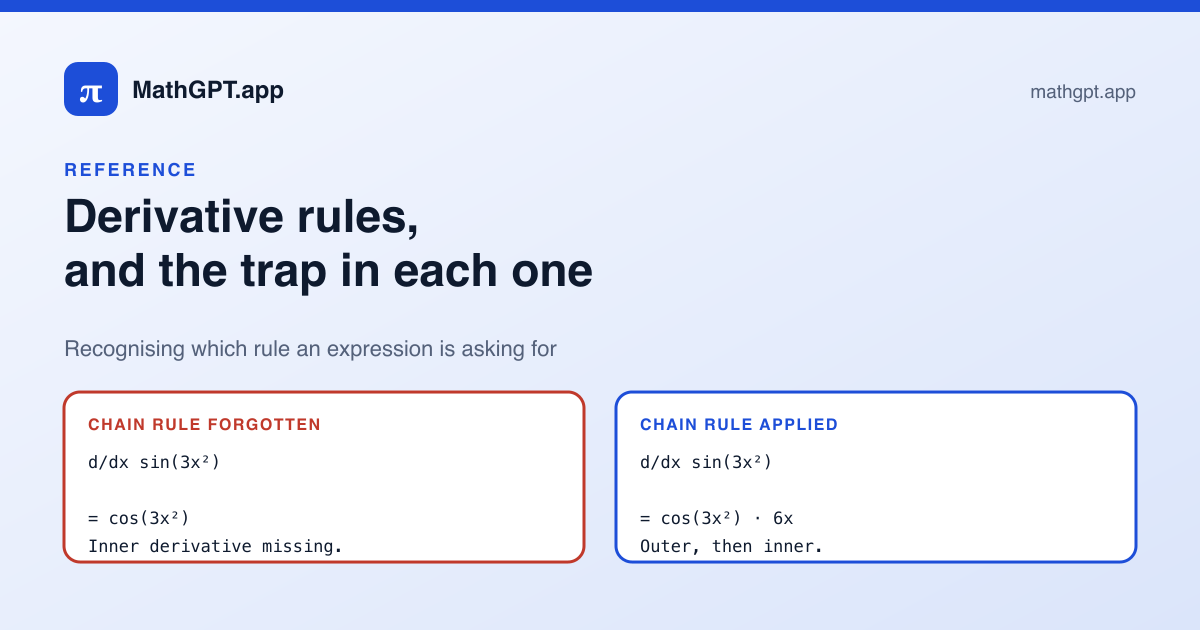
The chain rule is the one that gets missed
Roughly every second lost mark in a differentiation question is a missing inner derivative. The rule is easy; spotting that it applies is the skill.
- 1
Name the outer and inner functions out loud
"Sine of something" and "that something is 3x²." Writing u = 3x² takes three seconds and makes the structure impossible to miss.
- 2
Differentiate the outer, leaving the inner untouched
cos(3x²). Do not simplify anything inside the bracket at this stage — the bracket is what you still have to differentiate.
- 3
Multiply by the inner derivative
× 6x. This is the step that vanishes under time pressure.
- 4
Check the degree
Differentiating should usually lower the polynomial degree by one. If it did not, look for a factor you dropped.
Nested three deep, apply it three times: .
Two rules at once
Real exam questions rarely test one rule. is a product whose second factor needs the chain rule, and the usual failure is applying the product rule correctly and then forgetting the inner derivative inside it.
Work outside in, one rule per line, and do not simplify until the differentiating is finished. Simplifying halfway through is how terms get lost.
How to check a derivative
- Degree check. A polynomial derivative drops one degree. If yours did not, something is missing.
- A numerical check. Pick , compute your derivative there, and compare against . They should agree to two or three decimal places.
- Sign sanity. Where the original function is clearly increasing, the derivative must be positive. A sign error usually shows up immediately on a rough sketch.
Every rule above has its own page with worked examples — the chain rule, the product rule and the rest are under derivatives. To check your own differentiation, the working checker will point at the first line that goes wrong.