Using AI for Math Homework Without Cheating Yourself
Which uses of a maths solver leave you able to do it in an exam and which do not, plus a five-step workflow built around checking your own work rather than replacing it.
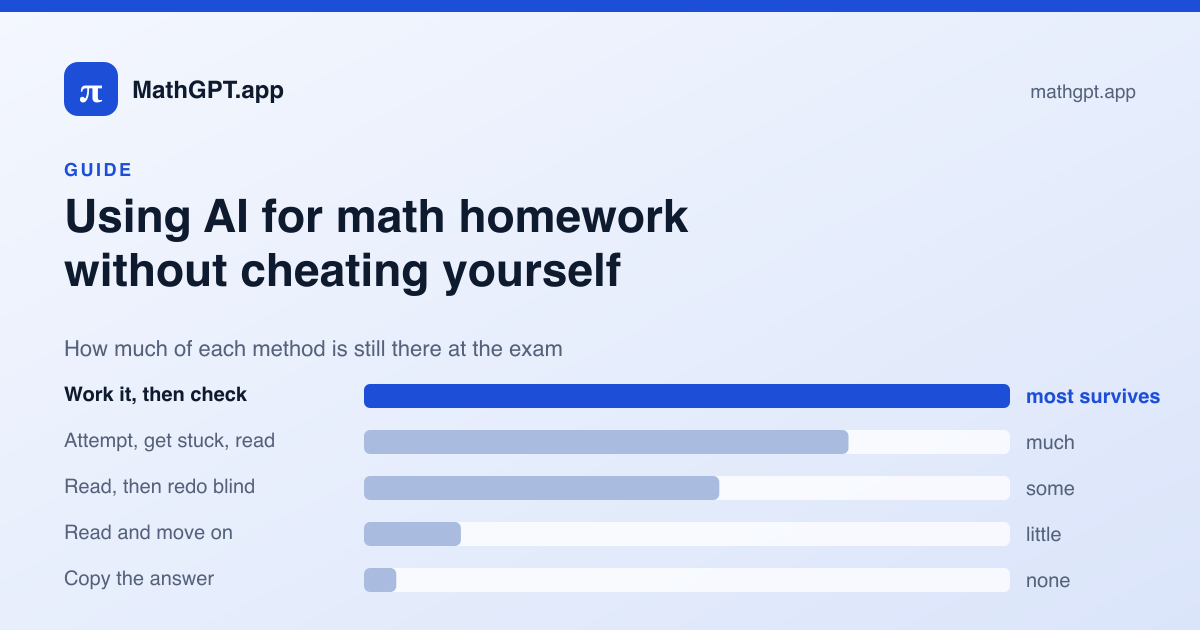
The honest version of this question is not "is using an AI solver cheating". It is "which uses of it leave me able to do the thing in an exam, and which leave me unable to". Those have clearer answers.
Your institution's rules are a separate matter and they override everything here. Read them. What follows is about learning.
Two uses that look identical and are not
Reading a worked solution produces a strong feeling of understanding. The feeling is not evidence — it is the fluency of following someone else's reasoning, and it fades within a day. Producing the solution yourself feels harder and lasts.
This is the best-documented finding in learning research, and it is uncomfortable precisely because the effective method feels worse while you are doing it.
You had to retrieve the method. Checking afterwards costs nothing and fixes the errors.
The stuck attempt is what makes the solution stick. Do not skip it.
The redo is doing the work. Without it this drops to the bottom row.
Feels productive, produces almost nothing a week later.
Plus whatever your school does about it.
A workflow that actually helps
- 1
Attempt every problem first, badly if necessary
Ten minutes, no help. A wrong attempt is far more useful than no attempt: it gives you something specific to compare against, and the sticking point is the thing you needed to find.
- 2
Check your working, do not request a solution
Paste what you did and ask which line is the first one that is wrong. You get a diagnosis rather than a replacement, and a diagnosis is the only output that tells you something about you.
- 3
Redo the problem from scratch
Not from your corrected working — from a blank line. If you cannot reproduce it, you have not learned it yet, and better to find that out now.
- 4
Generate three more of the same kind
Where the actual learning happens. Same shape, new numbers, no help. If all three come out right, the method is yours.
- 5
Write down the error in one line
"I distribute the minus over the first term only." A list of your own recurring errors is the most efficient revision document you will ever make.
Which mode for which situation
| Use | Why | |
|---|---|---|
| Answer doesn't match the book | Check my work | You need the divergent line, not another solution |
| No idea how to start | Solve, then redo it blind | You need a worked model — but only if you then reproduce it |
| One step doesn't follow | Explain | Ask about the step, not the problem |
| Method almost clicked | Practice problems | Three more of the same shape finishes the job |
| Revising for an exam | Practice problems | Retrieval beats re-reading, every time |
| Due in ten minutes | Be honest with yourself | This is the case the rules exist for |
Two things worth knowing
It can be wrong. A language model is not a computer algebra system. A long chain of manipulation is exactly where a sign error propagates into a confident, wrong answer with plausible working above it. Copying without reading is a bad strategy even ignoring every other consideration — sometimes you are copying a mistake.
Nothing you learn this way transfers by itself. An exam is a closed-book retrieval test. If every problem you have solved this term had help available, the first time you try without it will be the exam, and that is a bad moment to find out.
The short version
Attempt first. Check rather than request. Redo from blank. Practise the same shape until it is boring. Keep a list of your own errors.
The two modes worth building a habit around are the working checker and the practice generator. Neither hands you an answer, and between them they cover most of what a tutor would do.