ChatGPT for Math: Prompts That Actually Work
The four things to state in every maths prompt, the patterns that get reliable answers, and the three places a general chatbot is confidently wrong about maths.
A general chatbot is better at mathematics than most people expect and worse than its confidence suggests. The gap between those two is almost entirely about how the question was asked.
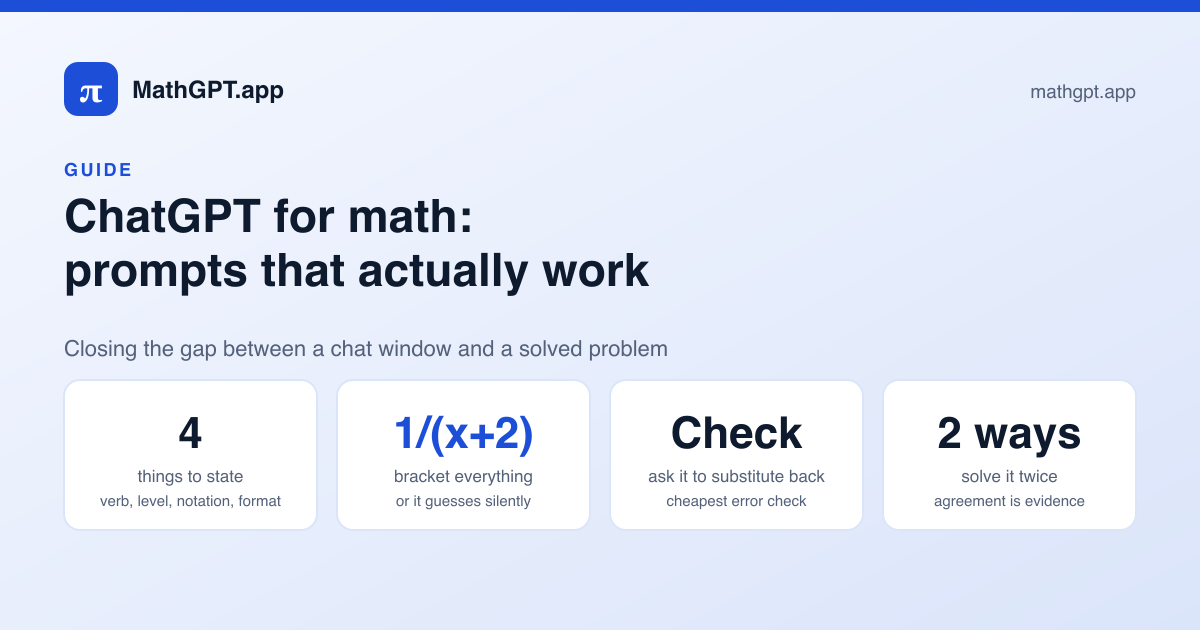
Four things to put in the prompt, the patterns that get reliable answers, and the three places it will be confidently wrong.
The four things to state
- 1
The instruction verb
Solve, simplify, factor, expand, prove, evaluate, sketch. These are five different answers to the same expression, and leaving it out means the model picks for you.
- 2
Your level
"I'm in Algebra 2 and haven't done calculus" changes the whole answer. Without it you will get L'Hôpital's rule on a limit your course wants you to do by factoring.
- 3
Unambiguous notation
Write (1/x) + 2 or 1/(x+2). "1/x+2" is genuinely ambiguous and the model has to guess, silently.
- 4
What you want back
"Show every step" or "just the answer, I'll do the working". Also: "tell me which rule you used and why that one".
A weak prompt and a strong one
Weak
solve 2x^2+5x-3No verb (solve for what — roots? factors?), ambiguous intent, no level. You get an answer, but not necessarily the one your course wants.
Strong
Solve 2x^2 + 5x - 3 = 0 for x.
I'm in Algebra 1 — use factoring if it
factors, otherwise the quadratic formula.
Show each step and check both roots by
substituting them back in.
Verb, level, method preference, and an explicit check. The check is the part people leave out and the part that catches errors.
The second prompt is four lines longer and roughly ten times more likely to give you something you can hand in.
Prompt patterns that work
- "Check my working, do not solve it." Paste your own attempt and ask which line is the first one that is wrong. This is the highest-value use of a model on maths, by a distance, and almost nobody asks for it.
- "Solve it a second way." Two independent methods arriving at the same answer is real evidence. Two methods disagreeing tells you to look closely, which is also useful.
- "What is this testing?" Often more useful than the solution — it tells you what to revise rather than what to write down.
- "Give me five more like this, answers at the end." Turns one solved problem into practice, which is what actually moves a grade.
- "Substitute the answer back in and show it holds." Ask for this every time. It is the cheapest error check there is.
Where it is confidently wrong
| Why it happens | What to do | |
|---|---|---|
| Long arithmetic chains | Each line looks locally plausible, so a slip propagates unnoticed | Ask for the check, and do the final substitution yourself |
| Ambiguous notation | It resolves the ambiguity silently and never mentions it | Bracket everything, or use a tool with a real formula editor |
| "Prove" questions | A fluent argument can contain a step that assumes the conclusion | Read each step as a challenge: does this follow, or is it being asserted? |
| Big numeric tables | Statistics and matrix work involve many small computations | Use a calculator or a CAS for the numbers; use the model for the method |
| Your specific syllabus | It does not know which techniques your course has covered | State your level and the method you are supposed to use |
What a chat window cannot fix
Two problems survive any amount of prompt engineering. The first is that maths comes back as text: a nested fraction printed as backslashes is hard to read and easy to misread, and reading is most of what you are there to do.
The second is input. There is no way to type into a chat box that is not a punctuation puzzle. A dedicated maths tool solves both by typesetting the output and giving you a two-dimensional field to type into — that is essentially the whole difference, and it is a bigger one than it sounds.
The side-by-side comparison goes through the rest, and the solver is there if you want to try the same problem in both.