How to Solve Quadratic Equations: 4 Methods Compared
Four ways to solve a quadratic equation and how to pick one in five seconds: factoring, the quadratic formula, completing the square and square roots.
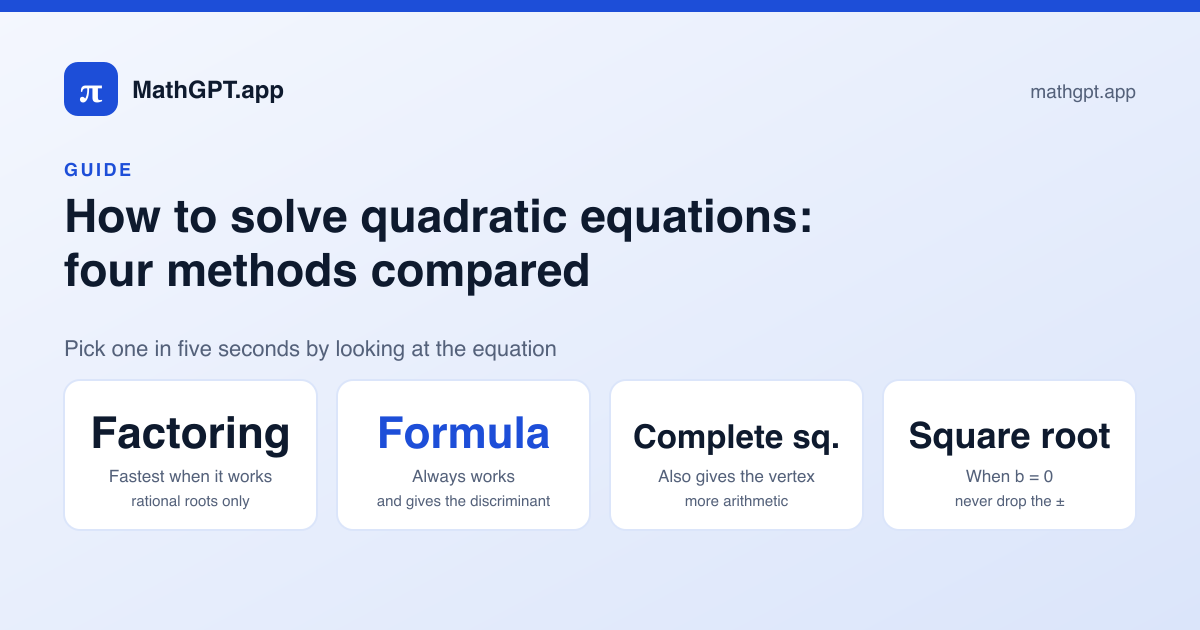
There are four ways to solve a quadratic equation, and the reason students find them confusing is that every one of them works on every quadratic. Nothing in the problem forces a method. What changes is how much arithmetic you do to get to the same two numbers.
So the useful question is not "which method is correct" but "which one is least work for this equation", and that you can usually decide by looking at it for five seconds.
Pick the method in five seconds
What does your equation look like once it is in standard form?
No linear term (b = 0)
Square root
Isolate the square and take the root of both sides. Two seconds, and the ± is the only thing to remember.
No constant term (c = 0)
Factor out x
x is a common factor, so one root is always 0. People miss that root by dividing both sides by x — never do that.
Integer roots look likely
Factoring
Two numbers multiplying to ac and adding to b. If you find them in a few seconds, this is the fastest route.
Anything else
Quadratic formula
Always works, never needs inspiration, and gives the discriminant for free.
Asked for vertex form
Complete the square
Not the fastest way to the roots, but the only one that also hands you the turning point.
1. Factoring
Factoring rewrites the quadratic as a product of two brackets, and then leans on one fact: if two things multiply to zero, one of them is zero. That is the zero product property, and it is the entire reason factoring solves anything.
Finding the brackets means finding two numbers that multiply to and add to — here 6 and −5, which gives −2 and −3. When the leading coefficient is not 1, the same idea applies with in place of , then split the middle term and factor by grouping.
Where it fails: it only works cleanly when the roots are rational. Spending ninety seconds hunting for factors of an equation that has none is the single biggest time sink in an algebra exam. Give it two attempts, then switch.
2. The quadratic formula
The formula solves every quadratic with no judgement required, which is exactly why it is worth memorising.
- 1
Get to standard form first
Everything on one side, equals zero. A formula applied to 2x² + 5x = 3 with c read as 3 rather than −3 gives two wrong roots that look perfectly plausible.
- 2
Write a, b and c down separately
Including their signs. Most quadratic formula errors are a lost minus sign on b, and they happen during substitution, not during the arithmetic.
- 3
Evaluate the discriminant on its own
b² − 4ac first, as a single number. If it is negative you can stop: there are no real roots, and you have saved yourself the rest.
- 4
Simplify the surd before splitting the ±
√48 becomes 4√3, and the fraction often cancels. Splitting first means simplifying the same expression twice.
Note that means the negative of whatever is. If then . Written out that is obvious; at speed, under exam conditions, it is the error that costs the most marks.
3. Completing the square
Completing the square turns the quadratic into a perfect square plus a constant. It is more work than the formula for finding roots — and it is the only method that also tells you where the parabola turns.
The move is always the same: halve the coefficient of , square it, add and subtract it. The vertex then reads straight off — here — which is what makes this the method to use when the question asks for a maximum, a minimum, or a sketch.
When , factor it out of the first two terms before you start. Forgetting to is why completing the square has a reputation for being fiddly.
4. The square root method
When there is no term, skip everything above.
The is not optional and it is not decoration. An even power destroys sign information, so taking a root has to put both possibilities back. Writing alone loses a mark and, in a word problem, loses half the answer.
What the discriminant tells you first
Before solving anything, tells you what kind of answer to expect — which is worth thirty seconds because it catches the arithmetic error you are about to make.
| What it means | Graph | Typical wording | |
|---|---|---|---|
| Δ > 0, a perfect square | Two rational roots | Crosses twice | Factoring will work |
| Δ > 0, not a square | Two irrational roots | Crosses twice | Leave the answer as a surd |
| Δ = 0 | One repeated root | Touches the axis | "Equal roots", "tangent to" |
| Δ < 0 | No real roots | Never crosses | "No real solutions" |
Questions that say "find such that the equation has equal roots" are discriminant questions wearing a disguise. Set and solve for .
Always check by substituting back
Two roots, two substitutions, thirty seconds. It catches every sign error and every arithmetic slip, and it is the one habit that separates people who lose marks on quadratics from people who do not.
There is a faster partial check as well: the roots of must sum to and multiply to . If your two answers do not, one of them is wrong and you know it before you have finished writing.
If you want the working checked rather than the answer produced, paste what you did into the working checker — it names the first line that does not follow. To practise a particular case, the practice generator will produce five more of the same shape, and the quadratic formula reference has the worked examples.